What is probiotic skin care, and does it work?
Probiotic skin care is designed to work with the microbes that live on your skin rather than against them. Some products contain live or dormant bacteria, some contain prebiotics that feed beneficial microbes, and some contain postbiotics, which are inactive bacteria or the substances they make. The research is promising but still early, so a gentle routine that protects your skin barrier matters more than any single product.
This article is for anyone curious about microbiome skin care who wants to understand it before buying. You'll learn what probiotic, prebiotic and postbiotic skin care mean, what the research says so far, how topical products differ from probiotics you eat or drink, and how to build a calm, simple routine.
What is probiotic skin care?
Key takeaways
- Your skin hosts a community of bacteria, fungi and other microbes, known as the skin microbiome.
- Microbiome skin care uses probiotics, prebiotics or postbiotics to work alongside those microbes.
- Research is still early: many studies are small, and results vary from person to person.
- Topical skin care and oral probiotics are different things, and one doesn't replace the other.
- A gentle routine that protects the skin barrier is the foundation, whatever products you choose.
Probiotic skin care is a broad name for products designed to support the skin microbiome, the mix of microbes that live on your skin. Most of these microbes are harmless or helpful, and together with the skin barrier they help keep the surface of your skin stable.
Rather than trying to remove bacteria, microbiome skin care aims to keep that community in balance. You can read more about how balance relates to breakouts in The Skin Microbiome and Acne.
Probiotic, prebiotic or postbiotic: what's the difference?
All three relate to microbes, but they work in different ways.
| What it is | In skin care | |
|---|---|---|
| Probiotic | Live microorganisms that, in adequate amounts, may offer a benefit | Live or dormant bacteria, such as Bacillus spores, added to a formula |
| Prebiotic | Ingredients that beneficial microbes selectively feed on | Certain sugars and plant fibres that help support a balanced community |
| Postbiotic | Inactive microbes, their fragments, or substances they produce | Ferments and lysates, often listed as "ferment filtrate" or "lysate" |
A 2023 review in Microorganisms notes that postbiotics can be easier to formulate than live bacteria, because they are more stable and don't need to stay alive on the shelf. Live bacteria are sensitive to heat, humidity and air, which is one reason some brands use dormant spores instead.
What does the research say so far?
It's promising, but early. The same 2023 review describes this research as "still in the initial stages" and calls for more human trials to confirm how well these products work and how safe they are over time.
A 2025 narrative review in the International Journal of Molecular Sciences reports that topical probiotics may support the skin's own defences and barrier in early studies. It also points out the limits: much of the evidence comes from lab and animal work, human trials are small, and there are no standard doses yet.
Microbiome skin care is cosmetic care. It may help skin look calmer and more balanced, but it isn't a treatment for eczema, rosacea, acne or any other skin condition. If you're managing a skin condition, see your healthcare provider or a dermatologist before adding new products.
Is a probiotic serum the same as a probiotic drink?
No. A serum works on the surface of your skin, while a probiotic you eat or drink travels through your digestive system. They are different products with different purposes.
Topical (on the skin)
- Applied to the face or body as a serum, cream or mist
- Designed to support the skin's surface and its microbes
- Judged by how your skin looks and feels
- Sold as cosmetics
Oral (food and drink)
- Taken as food, a drink mix or a supplement
- Designed for the gut and digestion
- Researchers are exploring a gut and skin connection, but it's not settled
- Not a substitute for skin care
Fermented foods, fibre-rich vegetables, fruit and whole grains are part of a varied diet, and a drink such as Blume SuperBelly, with prebiotic fibre and the probiotic culture BC30, can be an easy daily habit. Think of these as caring for the body as a whole, not as a skin treatment. That's the NOURISH idea: outside in and inside out, each doing its own job. The NOURISH Guide goes deeper.
How do you add microbiome skin care to your routine?
Start with the basics, then add one product at a time so you can notice how your skin responds.
- Cleanse gently, morning and/or night, with a mild cleanser and lukewarm water. Harsh, stripping cleansers can stress the barrier and the microbes that live on it.
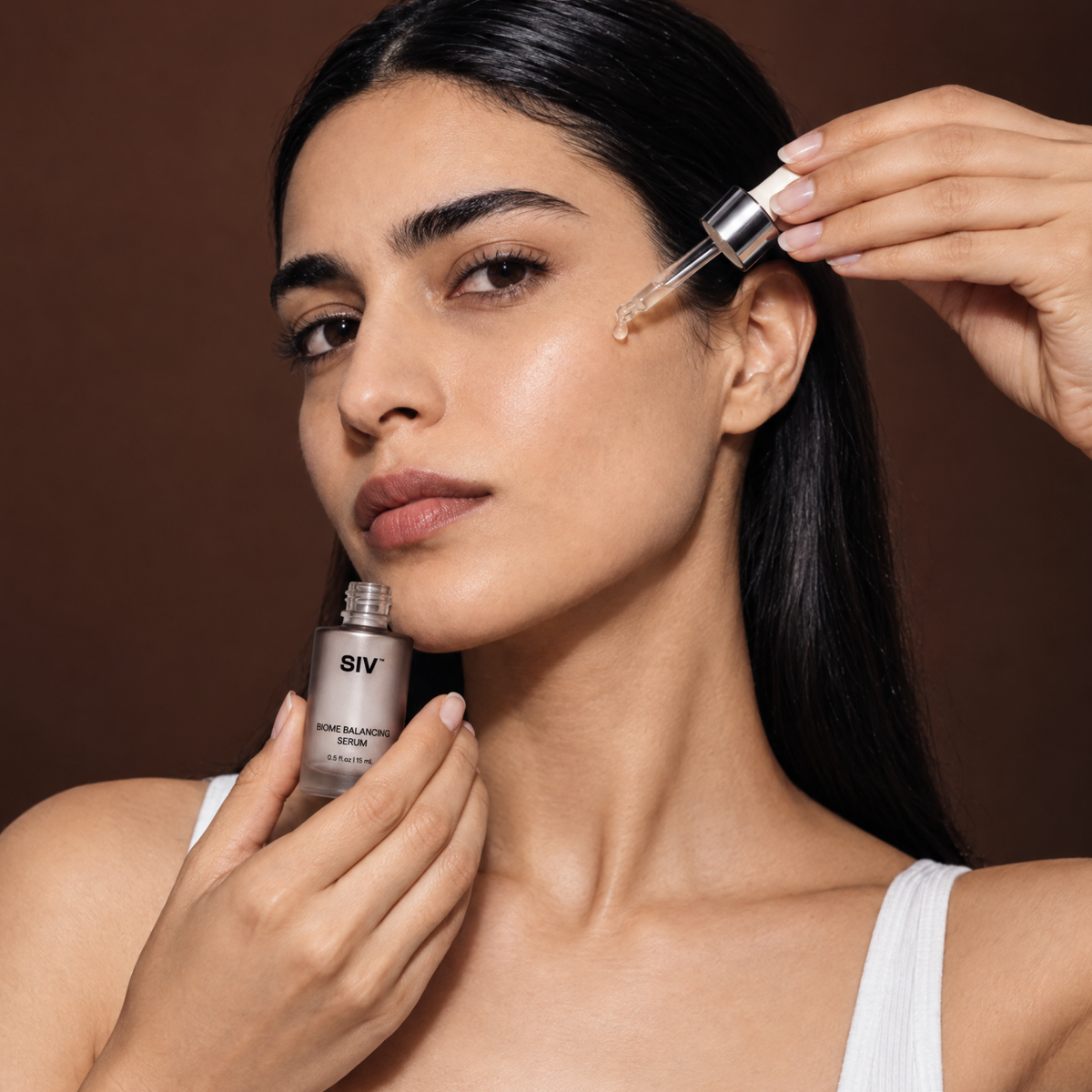
- Add one microbiome serum. SIV Biome Balancing Serum is made with Bacillus spores in squalane. Shake it well, then apply 1 to 3 drops once a day after cleansing.
- Moisturize. Follow with a moisturizer or a few drops of N°1 Squalane Oil to help skin hold on to moisture.
- Keep actives simple. If you use benzoyl peroxide, SIV suggests applying it at the opposite time of day. Introduce exfoliants and retinoids slowly.
- Give it time. Use a new routine for several weeks before deciding how it suits you, and patch test first if your skin is sensitive.
In winter, when the air is dry, barrier care matters even more. See Winter Skin in Canada for a seasonal routine, and Can a Stressed Skin Barrier Make Skin Look Tired or Dull? for how to support the barrier at every age.
How do you choose a microbiome skin care product?
Look for clarity rather than big promises.
- Check the ingredient list. Is it a probiotic (a named bacterium or spore), a prebiotic or a postbiotic (a ferment or lysate)?
- Prefer short, gentle formulas. Fewer ingredients and no added fragrance can be easier on reactive skin.
- Be wary of strong claims. Promises of quick or permanent results go beyond the research.
- Look at the whole routine. A microbiome serum works best alongside gentle cleansing and moisture, not in place of them.
Where to start

SIV Biome Balancing Serum
A light serum with a blend of Bacillus spores, made to work alongside your skin's microbiome and help it look calm, even and balanced. No added fragrance.

N°1 Squalane Oil
A single-ingredient oil from sugar cane that helps skin hold on to moisture and supports a healthy-feeling barrier. It also gives slip for the Gua Sha Guide practices.

Blume SuperBelly
For the inside-out side of NOURISH: a zero-sugar drink mix with prebiotic inulin fibre, the probiotic culture BC30 and electrolytes. A daily habit for the body, not a skin treatment.
FAQ
What is probiotic skin care?
It's skin care designed to support the skin microbiome, the community of microbes on your skin. Products may contain live or dormant bacteria (probiotics), ingredients that feed beneficial microbes (prebiotics), or inactive bacteria and their by-products (postbiotics).
Does probiotic skin care work?
Early research is promising, but studies are mostly small and results vary. Think of it as one supportive step in a gentle routine rather than a guaranteed result.
Can I eat yogurt or take a probiotic instead of using probiotic skin care?
They do different jobs. Food and oral probiotics are about the gut and the body as a whole, while topical products work on the skin's surface. Neither replaces the other.
Can I use a probiotic serum with other active ingredients?
Usually, yes. Introduce one new product at a time. SIV suggests using leave-on benzoyl peroxide at the opposite time of day to its serum.
Is microbiome skin care good for sensitive skin?
Many formulas are gentle and fragrance-free, and SIV lists its serum for all skin types, including sensitive. Patch test first, and stop if irritation occurs.
Can probiotic skin care treat eczema or acne?
No cosmetic product can treat a skin condition. If you have eczema, rosacea, persistent acne or another concern, see your healthcare provider or a dermatologist.