RELEASE Traditional Chinese Medicine
The Origins of Gua Sha: History, Meaning and Modern Practice
Gua sha is a traditional East Asian practice of stroking the skin with a smooth tool to move qi and blood and release stagnation. Its name means "to scrape sha", the reddish marks that can appear after firm strokes on the body. Facial gua sha is a much gentler, modern adaptation used for tension and self-care.
This article is for anyone who uses a gua sha stone and wants to understand where the practice comes from. You'll learn what the name means, how it was traditionally used, how facial gua sha developed, and what modern research does and doesn't say.
What does "gua sha" mean?
Key takeaways
- "Gua" means to scrape or press-stroke. "Sha" describes the reddish marks that can rise on the skin, and is often translated as "sand".
- Gua sha began as a folk practice used at home across East Asia, with tools like spoons, coins, horn and smooth stones.
- In Traditional Chinese Medicine, it was used to move qi and blood and release stagnation.
- Facial gua sha uses light pressure and should not leave marks.
- Research on gua sha is still limited, so tradition is offered here as context, not proof.
The name comes from two Chinese words. Gua means to scrape, or to press and stroke. Sha refers to the small reddish marks (petechiae) that can appear on the skin after firm strokes, and is often translated as "sand" because of how they look.
In traditional practice, those marks were seen as a sign that stagnation had been brought to the surface. Facial gua sha is different: it uses a light touch, and marks on the face are not the goal.
Where does gua sha come from?
Gua sha comes from Traditional Chinese Medicine (TCM) and the wider tradition of East Asian folk medicine. It was passed down in families and used at home, often on the back, neck and shoulders, with whatever smooth-edged tool was at hand: a porcelain spoon, a coin, a piece of horn or a polished stone.
Acupuncturist and TCM doctor Ping Zhang explains that gua sha was traditionally used for "the abrupt, immediate, sudden collapse of the body from heatstroke and seasonal diseases, like a cold virus." Over time, it became a familiar household practice for aches, tension and feeling unwell.
Bian stone has a special place in this history. It is one of the oldest materials associated with Chinese healing tools, and many practitioners still value it today. Our Four-Edge Bian Stone Gua Sha carries that tradition into a modern shape.
What is qi, and why does it matter in gua sha?
In TCM, qi (pronounced "chee") is often translated as vital energy, though many teachers say it is better understood as the activity that keeps the body functioning. Qi and blood are described as flowing through the body like water through a river.
When that flow is blocked, TCM calls it stagnation, and it may show up as tension, aches or a dull complexion. Gua sha was used to move qi and blood and release that stagnation. These are traditional teachings, offered here as context rather than medical advice. You can read more about TCM patterns in 9 TCM Body Types.
How did facial gua sha develop?
Facial gua sha is a modern, gentler adaptation of the traditional practice. Practitioners and educators such as Dr. Ping Zhang, esthetician Cecily Braden and acupuncturist Clive Witham helped bring it into facial care and introduce it to a Western audience.
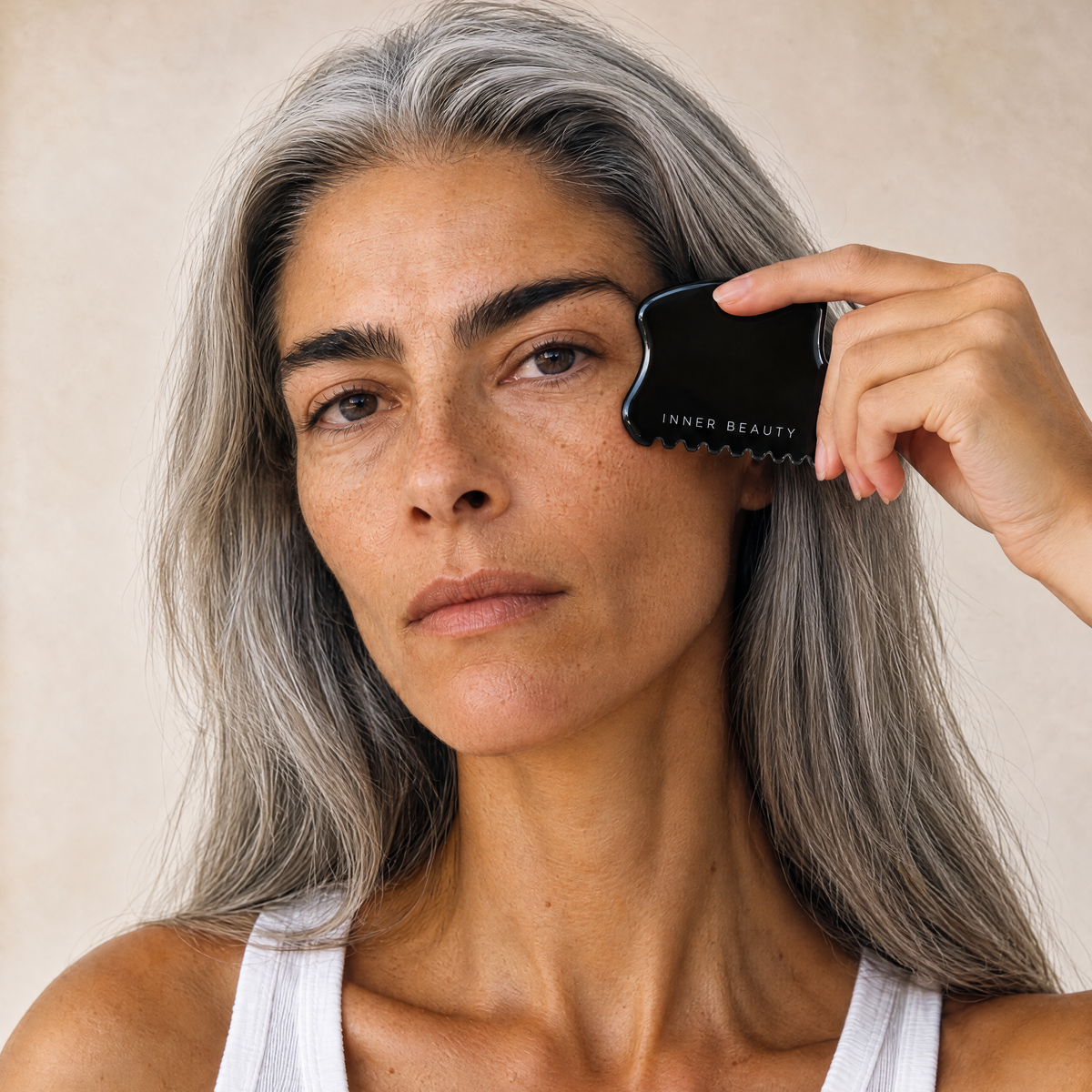
On the face, a smooth stone glides over skin prepared with a facial oil, with light to moderate pressure. Many people use it to ease tension in the jaw, brow and neck, and to give themselves a few quiet minutes. The way it is practised has changed, but the idea of caring for yourself at home has stayed the same.
Traditional gua sha
- Where: mostly the back, neck, shoulders and limbs
- Pressure: firm
- Tools: spoons, coins, horn, stone
- Marks: sha (petechiae) often appear and fade over a few days
- Used for: moving qi and blood, releasing stagnation
Facial gua sha
- Where: face, neck and décolleté
- Pressure: light to moderate
- Tools: shaped stones such as jade, rose quartz and bian stone
- Marks: none; light pinkness that settles quickly
- Used for: easing tension, a relaxing self-care practice
What does modern research say about gua sha?
Research is growing but still limited. An often-quoted 2007 pilot study by Arya Nielsen and colleagues, in 11 healthy adults, found that firm gua sha on the back increased surface blood flow about fourfold for roughly 25 minutes. That was body gua sha with firm pressure, not facial gua sha.
For the face, a 2023 review in the Journal of Cosmetic Dermatology concluded that the evidence is not yet strong enough to support anti-aging claims. That's why we describe gua sha as a practice that may ease tension and help you feel refreshed, not one that permanently changes the face. Learn how to use it well in the Gua Sha Guide.
Where to start

Four-Edge Bian Stone Gua Sha
A stone with deep roots in Chinese healing traditions, shaped for both face and body. See the Gua Sha Guide.

CJB Pro Nephrite Gua Sha by Cecily Braden
A professional nephrite jade tool designed by esthetician Cecily Braden. Nephrite has long been valued in Chinese culture.

Gua Sha Comb, Tiger's Eye
A modern take on the tradition for the scalp and body. Use it with a little oil, like N°1 Squalane Oil. See all gua sha and massage tools.
FAQ
What does gua sha mean?
"Gua" means to scrape or press-stroke, and "sha" describes the reddish marks that can appear on the skin after firm strokes. It is often translated as "scraping sand".
Where does gua sha come from?
Gua sha comes from Traditional Chinese Medicine and East Asian folk medicine, where it was used at home with spoons, coins, horn and smooth stones.
Is facial gua sha the same as traditional gua sha?
No. Traditional gua sha uses firm pressure on the body and can leave marks. Facial gua sha is a gentler modern adaptation with light pressure and no marks.
Should gua sha leave marks on my face?
No. A light pinkness that fades quickly is normal. If you see marks or bruising on your face, use less pressure.
What is a bian stone?
Bian stone is a stone long associated with Chinese healing tools. Many practitioners value it for gua sha, and it's used on both the face and body.
Is gua sha scientifically proven?
Research is still limited. Small studies on body gua sha show a short-term increase in surface blood flow, but evidence for facial anti-aging claims is not yet strong. We offer its tradition as context, not proof.